Infographic 10

How a Bail Bond Works

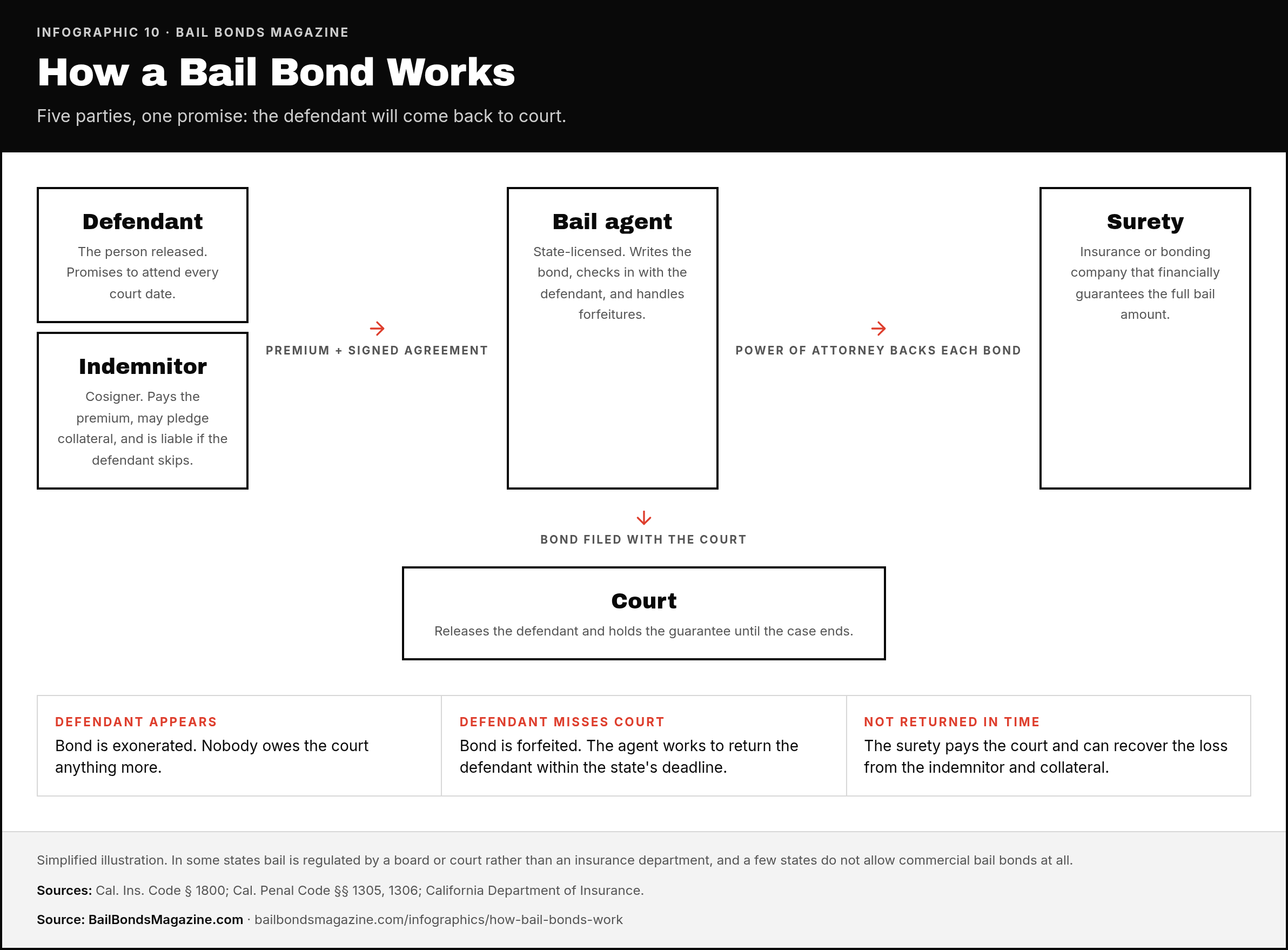
A bail bond is a three-way promise backed by an insurance company. This diagram shows the five parties involved and how money and responsibility flow between them.

Not legal advice · This infographic simplifies laws that vary by state and change over time. Sources are listed below; last reviewed 2026-11-01. Confirm details with the court, your state regulator or an attorney.

Infographic 10 · Bail Bonds Magazine

How a Bail Bond Works

Five parties, one promise: the defendant will come back to court.

Defendant

The person released. Promises to attend every court date.

Indemnitor

Cosigner. Pays the premium, may pledge collateral, and is liable if the defendant skips.

Premium + signed agreement

Bail agent

State-licensed. Writes the bond, checks in with the defendant, and handles forfeitures.

Power of attorney backs each bond

Surety

Insurance or bonding company that financially guarantees the full bail amount.

Bond filed with the court

Court

Releases the defendant and holds the guarantee until the case ends.

Defendant appears
Bond is exonerated. Nobody owes the court anything more.
Defendant misses court
Bond is forfeited. The agent works to return the defendant within the state's deadline.
Not returned in time
The surety pays the court and can recover the loss from the indemnitor and collateral.

Simplified illustration. In some states bail is regulated by a board or court rather than an insurance department, and a few states do not allow commercial bail bonds at all.

Sources: Cal. Ins. Code § 1800; Cal. Penal Code §§ 1305, 1306; California Department of Insurance.

Source: BailBondsMagazine.com · bailbondsmagazine.com/infographics/how-bail-bonds-work

Download or embed

Print-quality files include the “Source: BailBondsMagazine.com” credit. The responsive embed adjusts to any screen size.

Responsive embed (resizes to fit, works on mobile)

Image embed (static PNG with link)

Free to embed or republish unaltered with the “Source: BailBondsMagazine.com” credit and a link to this page. Please keep the disclaimer and sources.

Understanding this infographic

The parties

The defendant promises to appear. The cosigner (indemnitor) pays the premium and may pledge collateral. The licensed bail agent writes the bond as the surety's representative, and the surety guarantees the full amount to the court. In California, only licensed bail agents may negotiate or write bail (Insurance Code § 1800).

The outcomes

If the defendant appears, the bond is exonerated. If not, the bond is forfeited and the surety has a fixed period to return the defendant before judgment is entered (Cal. Penal Code §§ 1305, 1306).

Sources