Infographic 07

What Happens If Someone Misses Court

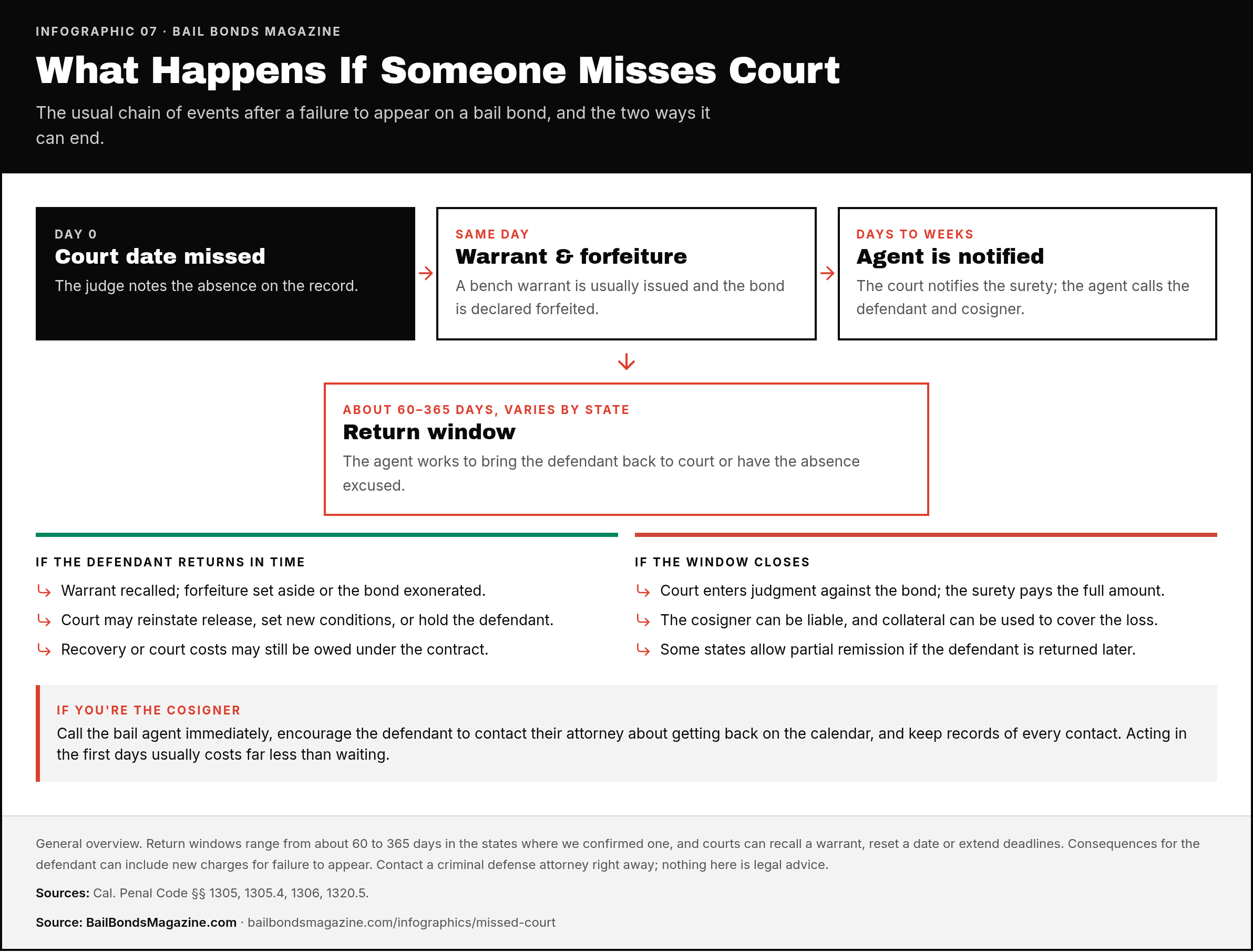
A missed court date sets off a predictable chain of events. This flow shows what usually happens next, how long the surety has to fix it, and what cosigners should do in the first days.

Not legal advice · This infographic simplifies laws that vary by state and change over time. Sources are listed below; last reviewed 2026-11-01. Confirm details with the court, your state regulator or an attorney.

Infographic 07 · Bail Bonds Magazine

What Happens If Someone Misses Court

The usual chain of events after a failure to appear on a bail bond, and the two ways it can end.

Day 0

Court date missed

The judge notes the absence on the record.

Same day

Warrant & forfeiture

A bench warrant is usually issued and the bond is declared forfeited.

Days to weeks

Agent is notified

The court notifies the surety; the agent calls the defendant and cosigner.

About 60–365 days, varies by state

Return window

The agent works to bring the defendant back to court or have the absence excused.

If the defendant returns in time

  • Warrant recalled; forfeiture set aside or the bond exonerated.
  • Court may reinstate release, set new conditions, or hold the defendant.
  • Recovery or court costs may still be owed under the contract.

If the window closes

  • Court enters judgment against the bond; the surety pays the full amount.
  • The cosigner can be liable, and collateral can be used to cover the loss.
  • Some states allow partial remission if the defendant is returned later.

If you're the cosigner

Call the bail agent immediately, encourage the defendant to contact their attorney about getting back on the calendar, and keep records of every contact. Acting in the first days usually costs far less than waiting.

General overview. Return windows range from about 60 to 365 days in the states where we confirmed one, and courts can recall a warrant, reset a date or extend deadlines. Consequences for the defendant can include new charges for failure to appear. Contact a criminal defense attorney right away; nothing here is legal advice.

Sources: Cal. Penal Code §§ 1305, 1305.4, 1306, 1320.5.

Source: BailBondsMagazine.com · bailbondsmagazine.com/infographics/missed-court

Download or embed

Print-quality files include the “Source: BailBondsMagazine.com” credit. The responsive embed adjusts to any screen size.

Responsive embed (resizes to fit, works on mobile)

Image embed (static PNG with link)

Free to embed or republish unaltered with the “Source: BailBondsMagazine.com” credit and a link to this page. Please keep the disclaimer and sources.

Understanding this infographic

Warrant and forfeiture

When a defendant on bail fails to appear without sufficient excuse, the court typically issues a bench warrant and declares the bond forfeited (Cal. Penal Code § 1305). In California, willfully failing to appear on a felony while on bail to evade the court is itself a separate felony (§ 1320.5).

Two ways it ends

If the defendant returns or the absence is excused within the return window, the forfeiture can be set aside or the bond exonerated, though costs may be owed. If the window closes, the court enters judgment against the bond (§ 1306), the surety pays, and the cosigner and collateral can be pursued for the loss.

What cosigners should do

Call the bail agent right away, encourage the defendant to contact their attorney about recalling the warrant or getting a new date, and keep a record of every contact. Acting early usually costs far less than waiting.

Sources