Infographic 02

Premium vs. Cash Bail vs. Court Deposit

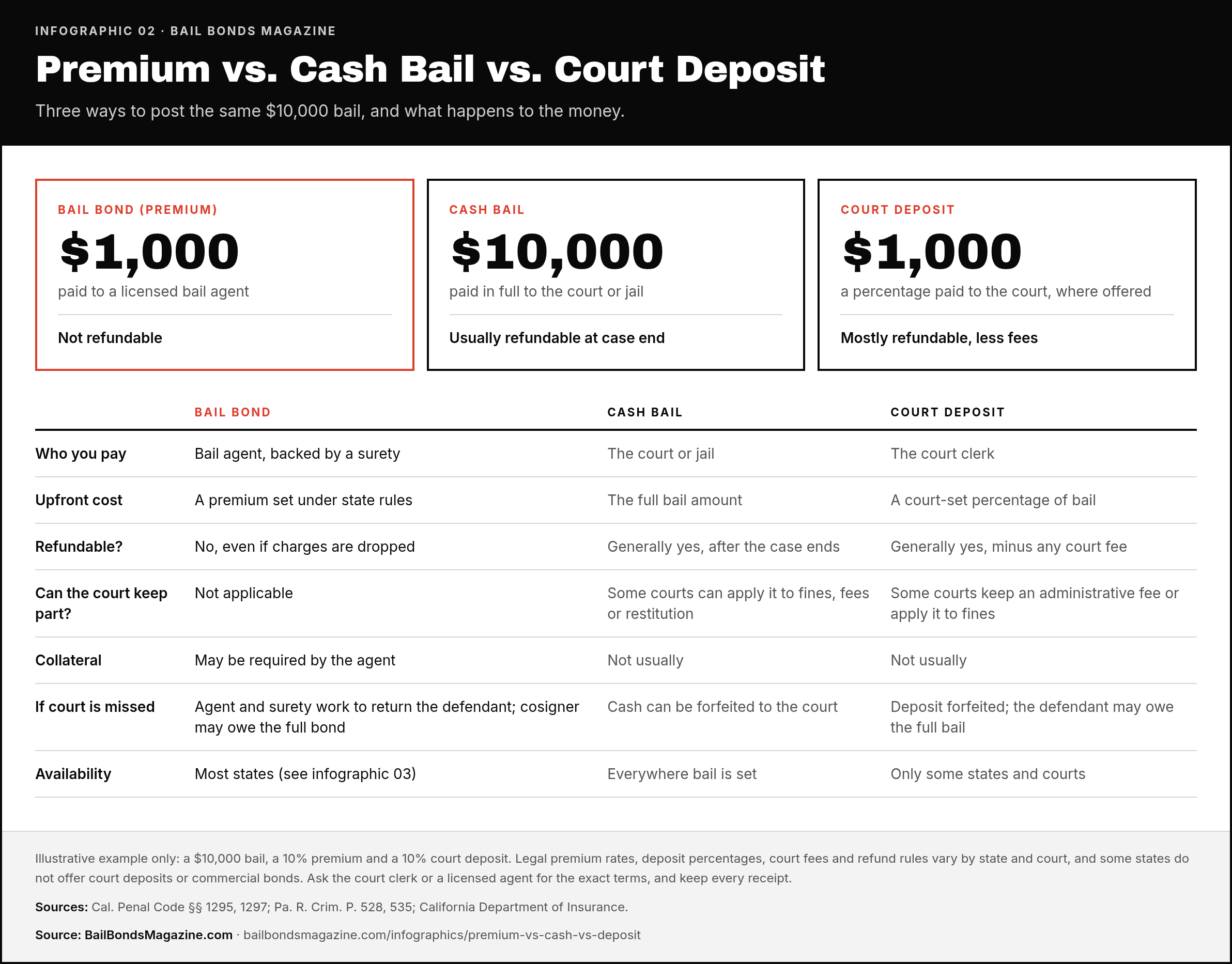
Families often hear three different numbers for the same bail. This comparison shows what each payment buys, who holds the money and what comes back when the case ends, using an illustrative $10,000 bail.

Not legal advice · This infographic simplifies laws that vary by state and change over time. Sources are listed below; last reviewed 2026-11-01. Confirm details with the court, your state regulator or an attorney.

Infographic 02 · Bail Bonds Magazine

Premium vs. Cash Bail vs. Court Deposit

Three ways to post the same $10,000 bail, and what happens to the money.

Bail bond (premium)

$1,000

paid to a licensed bail agent

Not refundable

Cash bail

$10,000

paid in full to the court or jail

Usually refundable at case end

Court deposit

$1,000

a percentage paid to the court, where offered

Mostly refundable, less fees

Comparison of bail bond premium, cash bail and court deposit
QuestionBail bondCash bailCourt deposit
Who you payBail agent, backed by a suretyThe court or jailThe court clerk
Upfront costA premium set under state rulesThe full bail amountA court-set percentage of bail
Refundable?No, even if charges are droppedGenerally yes, after the case endsGenerally yes, minus any court fee
Can the court keep part?Not applicableSome courts can apply it to fines, fees or restitutionSome courts keep an administrative fee or apply it to fines
CollateralMay be required by the agentNot usuallyNot usually
If court is missedAgent and surety work to return the defendant; cosigner may owe the full bondCash can be forfeited to the courtDeposit forfeited; the defendant may owe the full bail
AvailabilityMost states (see infographic 03)Everywhere bail is setOnly some states and courts

Illustrative example only: a $10,000 bail, a 10% premium and a 10% court deposit. Legal premium rates, deposit percentages, court fees and refund rules vary by state and court, and some states do not offer court deposits or commercial bonds. Ask the court clerk or a licensed agent for the exact terms, and keep every receipt.

Sources: Cal. Penal Code §§ 1295, 1297; Pa. R. Crim. P. 528, 535; California Department of Insurance.

Source: BailBondsMagazine.com · bailbondsmagazine.com/infographics/premium-vs-cash-vs-deposit

Download or embed

Print-quality files include the “Source: BailBondsMagazine.com” credit. The responsive embed adjusts to any screen size.

Responsive embed (resizes to fit, works on mobile)

Image embed (static PNG with link)

Free to embed or republish unaltered with the “Source: BailBondsMagazine.com” credit and a link to this page. Please keep the disclaimer and sources.

Understanding this infographic

Cash bail and deposits go to the court

Anyone can post cash with the court instead of a bond (Cal. Penal Code § 1295). The money is usually returned after the case, but if the defendant is the depositor the court can apply it to fines first (§ 1297). Some states allow a percentage deposit instead: Pennsylvania lets a bail authority accept a deposit of up to 10% of the full amount (Pa. R. Crim. P. 528), and the depositor becomes liable for the full bail if the defendant fails to appear (Rule 535).

A premium buys a surety's guarantee

With a bail bond, the family pays a licensed agent a premium and the surety guarantees the full amount to the court. The premium is the cost of that service and is not refundable, even if charges are dropped. Agents may also require collateral and a cosigner (indemnitor).

Which option is available

Cash bail is available wherever bail is set. Court percentage deposits exist only in some states and courts, and a handful of states do not use commercial bail bonds at all. Check with the court clerk before deciding, and compare the total cost — not just the upfront number.

Sources