Infographic 05

The Bail Forfeiture Timeline

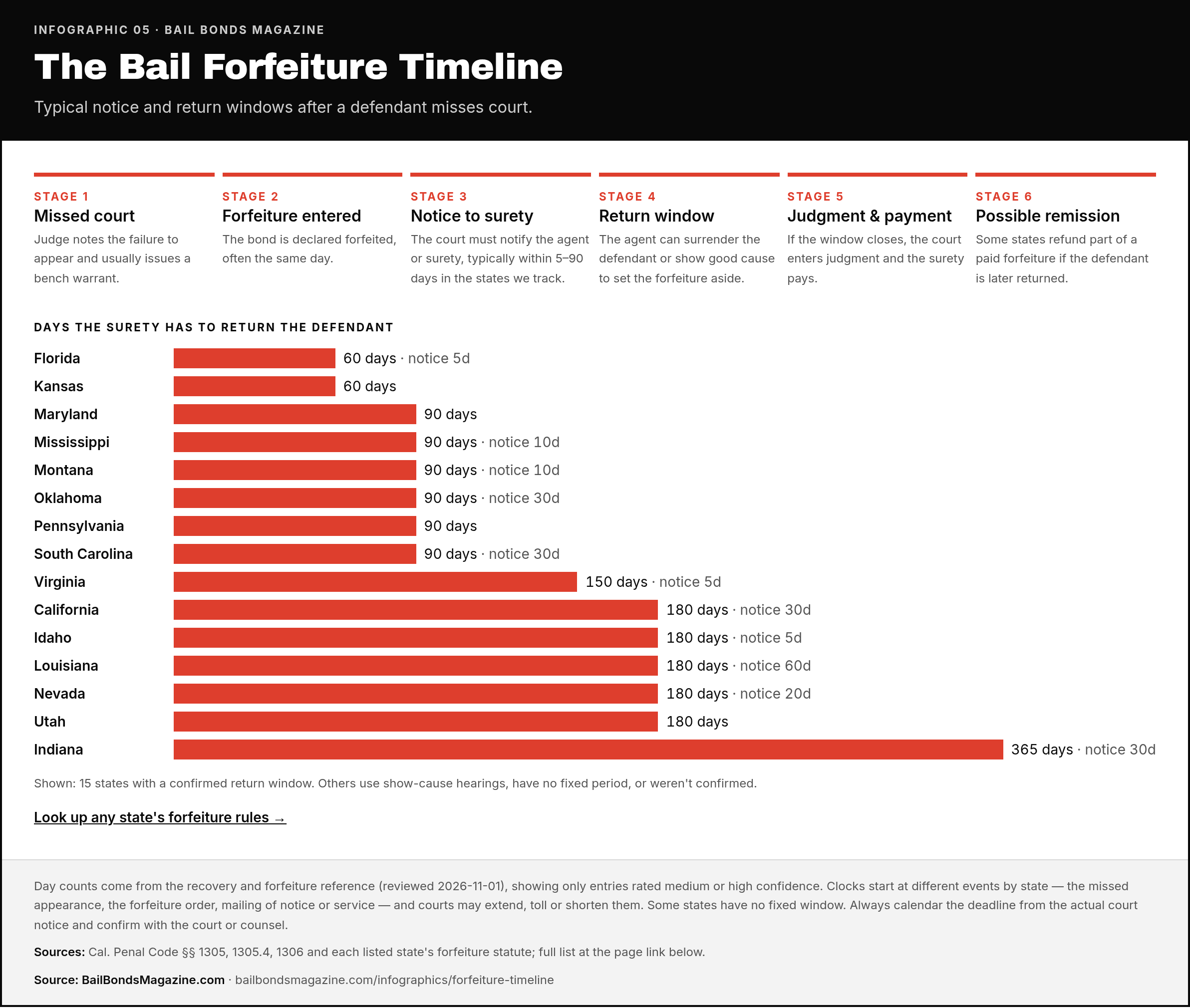
When a defendant misses court, the surety does not pay immediately. State law gives it a window to return the defendant or show good cause. This timeline shows the six common stages and the confirmed return windows in states we have verified.

Not legal advice · This infographic simplifies laws that vary by state and change over time. Sources are listed below; last reviewed 2026-11-01. Confirm details with the court, your state regulator or an attorney.

Infographic 05 · Bail Bonds Magazine

The Bail Forfeiture Timeline

Typical notice and return windows after a defendant misses court.

  1. Stage 1

    Missed court

    Judge notes the failure to appear and usually issues a bench warrant.

  2. Stage 2

    Forfeiture entered

    The bond is declared forfeited, often the same day.

  3. Stage 3

    Notice to surety

    The court must notify the agent or surety, typically within 5–90 days in the states we track.

  4. Stage 4

    Return window

    The agent can surrender the defendant or show good cause to set the forfeiture aside.

  5. Stage 5

    Judgment & payment

    If the window closes, the court enters judgment and the surety pays.

  6. Stage 6

    Possible remission

    Some states refund part of a paid forfeiture if the defendant is later returned.

Days the surety has to return the defendant

  • FL60 days · notice 5d
  • KS60 days
  • MD90 days
  • MS90 days · notice 10d
  • MT90 days · notice 10d
  • OK90 days · notice 30d
  • PA90 days
  • SC90 days · notice 30d
  • VA150 days · notice 5d
  • CA180 days · notice 30d
  • ID180 days · notice 5d
  • LA180 days · notice 60d
  • NV180 days · notice 20d
  • UT180 days
  • IN365 days · notice 30d

Shown: 15 states with a confirmed return window. Others use show-cause hearings, have no fixed period, or weren't confirmed.

Look up any state's forfeiture rules →

Day counts come from the recovery and forfeiture reference (reviewed 2026-11-01), showing only entries rated medium or high confidence. Clocks start at different events by state — the missed appearance, the forfeiture order, mailing of notice or service — and courts may extend, toll or shorten them. Some states have no fixed window. Always calendar the deadline from the actual court notice and confirm with the court or counsel.

Sources: Cal. Penal Code §§ 1305, 1305.4, 1306 and each listed state's forfeiture statute; full list at the page link below.

Source: BailBondsMagazine.com · bailbondsmagazine.com/infographics/forfeiture-timeline

Download or embed

Print-quality files include the “Source: BailBondsMagazine.com” credit. The responsive embed adjusts to any screen size.

Responsive embed (resizes to fit, works on mobile)

Image embed (static PNG with link)

Free to embed or republish unaltered with the “Source: BailBondsMagazine.com” credit and a link to this page. Please keep the disclaimer and sources.

Understanding this infographic

California as an example

In California the court declares the bond forfeited in open court, notice must be mailed to the surety and agent within 30 days for larger bonds, and the surety then has 180 days (plus 5 for mailing) to return the defendant or get the forfeiture set aside (Penal Code § 1305). The period can be extended for good cause (§ 1305.4). If it expires, the court enters summary judgment for the bond amount (§ 1306).

Reading the chart

Bars show the number of days the surety has to return the defendant in each state where we confirmed a figure at medium or high confidence. Clocks start at different events — the missed appearance, the forfeiture order or the mailing of notice — so the bars compare length, not identical procedures. Some states use show-cause hearings with no fixed window.

Remission after payment

Several states let the surety recover part of a paid forfeiture if the defendant is returned later. Kansas, for example, sets mandatory remission percentages that shrink over time. Agents should calendar every deadline from the actual court notice.

Sources