Legal Safety for Bail Bondsmen: Understanding Body Armor Laws
Body armor can be part of a bail agency’s safety plan, but purchasing and wearing it raises separate legal questions. Understand possession restrictions, occupational eligibility, recovery authority, equipment standards, and documentation before treating a vest as routine work gear.
By Bail Bonds Magazine Staff
Oct 18, 2026 · 6 min read
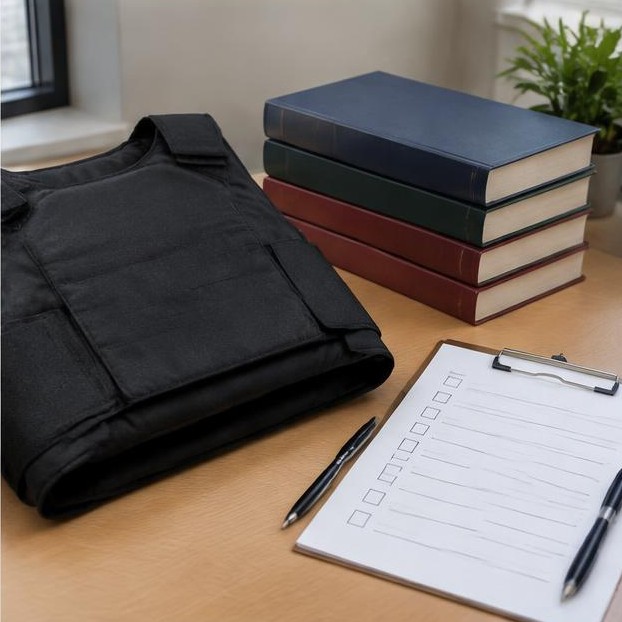
A protective vest may seem like a straightforward equipment purchase for a bail agency. The legal questions are less straightforward: Who may possess it, how may it be acquired, where may it be worn, and what authority does the wearer actually have? Those questions become especially important when an agency works across state lines or hires independent recovery personnel. A lawful purchase in one state does not settle another state’s rules, and wearing armor never supplies arrest powers or permission to enter property. For owners and supervisors, the practical task is to connect equipment decisions with licensing, assignment review, employee eligibility, and insurance. A defensible policy begins before a vest is ordered, not after someone challenges its use.
By Bail Bonds Magazine staff
Separate Armor Eligibility From Occupational Authority
Body armor law and bail licensing law answer different questions. One concerns whether a person may purchase, possess, or use protective equipment. The other concerns whether that person may perform a particular bail-related function. An individual can satisfy one set of requirements and fail the other. Agencies should not treat a bail license, recovery credential, or training certificate as automatic approval to obtain armor.
Federal law provides an important baseline. Under 18 U.S.C. § 931, certain people convicted of qualifying violent felonies are prohibited from purchasing, owning, or possessing body armor. The statute includes a limited affirmative defense involving necessary employment use and prior written employer certification. That is not a general exemption for anyone working in bail. An employer should obtain legal advice before considering such a certification rather than relying on a job title or verbal assurance. The statutory text is available at https://uscode.house.gov/view.xhtml?req=granuleid:USC-prelim-title18-section931&num=0&edition=prelim.
State restrictions may apply independently. Review individual eligibility through a lawful, appropriately limited process, and obtain counsel’s guidance when a record raises questions. A vendor’s willingness to complete a sale is not a legal determination.
Check State Purchase and Possession Rules Before Ordering
States do not regulate armor uniformly. Depending on the jurisdiction, relevant rules may address possession by prohibited persons, permitted purchasers, sales procedures, or use while committing an offense. Definitions also matter: a statute may define body armor differently from a supplier’s catalog. Soft armor, protective plates, and a carrier without protective inserts should not be assumed to receive identical treatment under every law.
New York illustrates why occupational eligibility needs a separate review. Its body armor purchase and possession framework includes eligible professions and an official process addressing occupational eligibility. An agency should verify the current rules rather than assume that bail work qualifies as law enforcement. New York’s official guidance is available at https://dos.ny.gov/body-armor. Other states may impose transaction requirements without using the same occupational framework.
For a hypothetical example, an agency orders vests for staff members who occasionally travel into another state. The supplier accepts payment and ships them legally to the office. That transaction does not establish that every recipient may possess the armor or take it into the destination state. Before distribution, the agency should verify the wearer, product, destination, and intended work. Repeat that review when assignments or applicable laws change.
California Recovery Work Requires Its Own Legal Review
California agencies must distinguish armor restrictions from recovery authority. California Penal Code § 31360 addresses body armor possession by people convicted of specified violent felonies and provides a limited relief process. A bail-related occupation does not erase that restriction. Agencies facing an eligibility question should consult the current statute and qualified counsel, not rely on informal industry understandings.
Separately, California Insurance Code § 1800 requires licensure for bail fugitive recovery work. A course completion certificate alone is insufficient. Current California Department of Insurance requirements are published at https://www.insurance.ca.gov/0200-industry/0050-renew-license/0200-requirements/Bail-Fugitive-Recovery-Agent.cfm. Older descriptions suggesting that California recovery agents are unlicensed should not guide staffing or equipment policies.
California Penal Code §§ 1299–1299.12 also establishes conditions governing recovery work, including requirements concerning written authorization, identification, and local notification. Armor does not substitute for any of them. Before an assignment, the responsible supervisor should verify the person’s authority, required documentation, and applicable notification obligations. California credentials do not create nationwide reciprocity; work elsewhere requires a separate review of that jurisdiction’s law. Keeping these checks distinct prevents an equipment approval from being mistaken for authorization to carry out a recovery.
Make Identification Clear Without Implying Police Powers
A vest can change how clients, bystanders, property occupants, and responding officers perceive a bail professional. That creates an identification problem as well as an equipment issue. Patches, badges, agency names, and other markings should accurately describe the wearer’s lawful role and comply with applicable restrictions. Labels or designs that imply government authority can create confusion even when the wearer intends only to identify an employer.
A written policy should explain approved markings and who authorizes changes. It should also require personnel to carry the identification and assignment documents applicable to their work. A visible company name does not replace legally required credentials, and possession of credentials does not permit someone to claim police powers.
Consider an illustrative assignment at a residence where the occupant questions the agent’s identity. The professional response is to verify identity and lawful authority, respect applicable consent and entry rules, and pause for legal clarification when necessary. The vest supplies no additional authority. Agencies should explicitly reject the idea that protective equipment justifies pressing ahead with an uncertain assignment. Safety planning includes deciding when not to proceed.
Evaluate Protection, Fit, and Care Separately From Legality
Legal armor is not necessarily suitable armor. Different products are designed for different hazards, and no vest protects against every threat. Ballistic protection should not be assumed to include stab protection, or vice versa. Procurement decisions should follow a documented assessment of actual duties rather than marketing language or appearances.
The National Institute of Justice publishes information about ballistic armor standards and testing at https://nij.ojp.gov/topics/equipment-and-technology/body-armor. Agencies should verify the exact model and applicable compliance information rather than rely on a generic claim that a product is “NIJ tested.” Protective inserts and carriers must be compatible, and alterations should not be made without manufacturer approval.
Fit, condition, storage, and maintenance affect whether equipment remains serviceable. Establish a fitting process and follow manufacturer instructions for inspection, cleaning, storage, and replacement. Record damage and remove questionable equipment from service pending qualified evaluation. Used armor with an unknown history deserves particular scrutiny. Heat, weight, and restricted movement also belong in the assessment. Armor is one safety measure, not a replacement for sound judgment, communication, medical readiness, or declining work outside the agency’s lawful capabilities.
Build a Documented Policy Before Issuing Equipment
A useful armor policy assigns responsibility. One person should own legal-rule verification, another may manage purchasing and inventory, and supervisors should confirm assignment-specific authority. Smaller agencies may combine these roles, but the checks should remain identifiable. Record the basis for eligibility decisions without collecting unnecessary sensitive personal information, and restrict access to personnel records.
Keep purchase records, model information, issue dates, inspection notes, and manufacturer guidance together. Review contractor arrangements as well as employee use: ownership of a vest does not establish a contractor’s licensing or eligibility. Discuss equipment and duties with the agency’s insurance adviser rather than assuming that wearing armor changes coverage. Any relevant restrictions or coverage questions should be resolved before deployment.
The practical takeaway is to maintain separate approvals for the person, the equipment, and the assignment. Verify current federal and state restrictions; confirm licensing and recovery authority; choose appropriate protection; and document issuance, care, and review. Recheck when personnel, jurisdictions, or duties change. Body armor can support a safety program, but only lawful authority, clear identification, and disciplined decisions make that program defensible.
Get the Weekly Brief
More in this section

Skip Tracing Fundamentals: A Legal and Ethical Primer
Effective skip tracing starts with verified records, clear authority and disciplined information handling. This primer explains how bail professionals can evaluate leads, protect sensitive data and recognize when locating someone requires additional legal review rather than another database search.
Bail Bonds Magazine Staff · Oct 27, 2026 · 6 min

Recovery Powers Vary by State: What Bail Professionals Must Verify
A recovery assignment does not carry the same authority across state lines. Licensing, written authorization, notification, custody and transport requirements can change. Here is how bail professionals can evaluate an assignment without confusing a bond contract with nationwide enforcement power.
Bail Bonds Magazine Staff · Oct 24, 2026 · 6 min

Apps in the Modern Recovery Toolkit: Better Records, Clearer Authority
Recovery software should do more than organize names and addresses. A practical toolkit helps agencies verify authority, protect sensitive information, document decisions and coordinate lawful work—without mistaking a map pin, database match or automated reminder for permission to act.
Bail Bonds Magazine Staff · Oct 20, 2026 · 6 min