How to Pick the Right Location for Your Bail Bond Business
The right bail bond office balances client access, lawful operations, privacy, staffing and manageable overhead. Before signing a lease, evaluate the actual release process, local restrictions, after-hours access and total occupancy costs—not simply the distance to the nearest jail.
By Bail Bonds Magazine Staff
Oct 24, 2026 · 6 min read
By Bail Bonds Magazine staff
A bail bond office needs to work for people making difficult decisions under time pressure. That means more than a visible sign near a detention facility. Clients need somewhere they can find, enter safely and discuss financial obligations without being overheard. Staff need reliable communications, secure records and a workable connection to the facilities and courts the agency serves. The owner needs a lease that supports lawful operations without consuming the money required for staffing and service. A location that looks ideal on a map can fail those tests after dark or when building restrictions surface. Before choosing an address, examine how a client moves from the first phone call to a completed transaction—and how the office supports that process.
Map the Service Area Before Touring Properties
Start with the jurisdictions and facilities your agency is authorized and equipped to serve. Identify detention locations, courts, relevant administrative offices and the public entrances clients actually use. A courthouse address does not necessarily tell you where someone is held or released. Verify procedures through official facility information rather than assuming that every transaction requires the same physical trip.
Build a realistic picture of the people who will visit your office. Some will come from a jail lobby; others will travel from work or home to discuss documents, payments or collateral. An indemnitor may live far from the detention facility. A site near major roads or public transportation may therefore be more useful than one directly across from a jail but difficult to reach from surrounding neighborhoods.
Distance still matters, but measure it against actual work. Consider travel required for tasks that cannot be completed remotely, available parking and staff coverage during those trips. Do not build the business case around promised release speed. Booking status, court orders, facility processing and other circumstances outside the agency's control can affect release timing regardless of the office address.
Confirm the Address Supports Lawful Operations
Before paying a nonrefundable deposit, verify that the proposed use is allowed. Ask the local planning or zoning office about the specific property and describe the business accurately. Confirm applicable business licensing, occupancy, signage and accessibility requirements. Obtain written answers where possible and retain them with the lease records. A landlord's assurance that “professional offices are allowed” is not a substitute for checking requirements that apply to a bail agency.
State licensing rules also shape location decisions. Do not assume that an individual license automatically resolves requirements for an agency, branch office, business name or address change. Check with the appropriate regulator before committing to a new office. Requirements differ across states; North Carolina's licensing provisions, for example, are separate from California's. An office near a state line does not create authority to conduct licensed business on both sides.
Proximity to a jail or courthouse also calls for a careful review of solicitation rules. Do not plan on approaching people in restricted areas or obtaining referrals through improper arrangements. Ask qualified counsel about uncertain practices before making them part of the revenue forecast. California operators can begin with the Department of Insurance's bail information at https://www.insurance.ca.gov/01-consumers/170-bail-bonds/, then confirm the requirements relevant to their particular office and activities.
Test Access as a Client Would Experience It
Visit shortlisted properties during the hours the agency expects to serve clients, not only during a scheduled daytime showing. Check whether visitors can identify the entrance, understand parking restrictions and reach the office without navigating locked corridors. Evaluate lighting, accessible routes, elevators and the availability of assistance when building management is absent. Confirm who controls exterior lighting and who handles maintenance problems.
Consider a hypothetical agency comparing two spaces. One has a prominent jail-adjacent address, but its shared lobby locks early and parking is limited to short stays. The other is farther away, with a clearly marked entrance, accessible parking and landlord-approved evening access. The second may better support an unhurried discussion of obligations. The comparison should turn on verified conditions, not the assumption that the closest office always wins.
Think about waiting as well as arrival. A client may bring a relative or need time to contact another signer. Provide a place to sit without exposing another household's paperwork or conversation. If appointments are required after certain hours, make that clear in advertising and telephone messages. Do not present an office as continuously staffed when it operates by appointment outside normal hours.
Design for Private Conversations and Secure Records
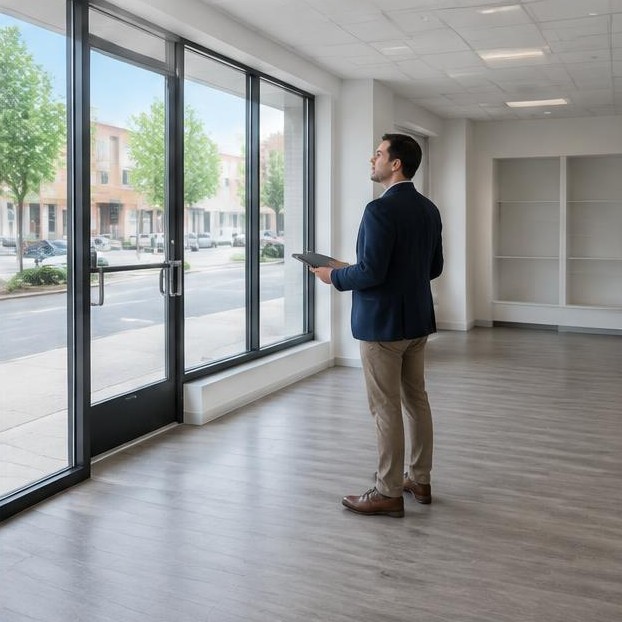
A bail transaction can involve identification documents, financial information and sensitive family circumstances. Evaluate whether the floor plan allows staff to discuss these matters away from the reception area. Listen for sound traveling through shared walls or meeting-room doors. Glass frontage may help visibility, but visitors should not be able to read documents or computer screens from the sidewalk.
Separate public areas from records storage and staff workstations. Plan for lockable storage, controlled access and secure disposal rather than leaving those decisions until move-in. Verify internet service options and whether the agency can manage its own network. Shared building connectivity should not be accepted without an appropriate security review. Ask a qualified technology provider to assess the proposed setup before installation.
The Federal Trade Commission's guide at https://www.ftc.gov/business-guidance/resources/protecting-personal-information-guide-business recommends limiting information collection, restricting access, controlling retention and planning for incidents. Those principles have direct space implications: fewer unnecessary paper copies require less storage, while restricted files require storage that visitors and unrelated tenants cannot access. Privacy-law obligations require a separate coverage analysis; not every bail agency is automatically covered by the California Consumer Privacy Act.
Compare Total Occupancy Cost, Not Just Rent
Prepare an occupancy budget for each serious candidate. Include base rent, operating charges, utilities, internet, insurance, parking, signage, cleaning, security and maintenance obligations. Add one-time expenses such as deposits, permits, furniture, sound reduction and accessibility work allocated to the tenant. Request documentation for variable charges and understand how increases are calculated. An inexpensive suite can become costly when essential improvements are excluded from the advertised rent.
Translate the location's features into staffing requirements. A separate entrance may simplify evening appointments, but it does not make those appointments free to operate. An isolated office may require additional safety measures or staffing. Conversely, a cheaper property far from routine business destinations may add travel time and leave the office uncovered. Budget for the operating model the address requires, not an ideal schedule that assumes everyone is always available.
Review the lease with commercial real estate counsel before signing. Pay attention to permitted use, access hours, sign rights, repair obligations, personal guarantees, renewal terms and options if approvals are denied. Where feasible, negotiate appropriate contingencies before becoming fully committed. Keep working capital available for operations rather than using the entire opening budget to secure a prestigious address.
Make the Final Decision With a Documented Site Review
Use the same written review for every finalist. Record confirmed permissions, unresolved questions, client access, privacy, staffing demands and total costs. Distinguish fixable defects from disqualifying conditions. Better signs may solve an unclear entrance; they will not solve a prohibited use or a building policy that prevents necessary appointments. Assign responsibility and a realistic cost to each required improvement before deciding.
The practical takeaway is straightforward: choose the address that supports reliable service, not merely the most recognizable corner. Verify legal use before committing, test access outside daytime showing hours, protect private conversations and price the entire operation. Keep records of approvals and lease promises, then make sure public listings accurately describe the office's hours and accessibility. A well-chosen location gives clients a dependable place to make informed decisions and gives the agency room to operate responsibly.
Get the Weekly Brief
More in this section

Working Without Paid Search: How Bail Agencies Build Visibility After the Platform Bans
Learn how bail agencies build steady call volume without paid search through local map optimization, client reviews, attorney networks, and targeted content.
Bail Bonds Magazine Staff · Oct 30, 2026 · 5 min
Attracting and Keeping Newer Agents in a Relationship-Driven Business
Learn how bail agency owners can attract, train, and retain new agents lacking family ties to the trade through structured mentorship and operational support.
Bail Bonds Magazine Staff · Oct 30, 2026 · 5 min
The Hidden Costs of Aggressive Premium Financing and Low-Down Practices
Aggressive premium financing carries hidden operational risks. Learn how low-down practices impact underwriting quality, collections, and surety standing.
Bail Bonds Magazine Staff · Oct 30, 2026 · 5 min